AI is freeing up capacity in nature-based projects. Will we use it - or waste it?

AI is changing how work gets done across every sector. That much is clear. In nature-based carbon projects - one of the key mechanisms to finance conservation and restoration - the consequences are starting to become very tangible. We are seeing something shift that has held this market back for years. A large share of time and cost tied up in certification, documentation, and early-stage project development is beginning to fall away. This raises a simple but uncomfortable question: If we suddenly free up capacity in a system that has struggled to deliver nature finance impact at scale - what do we do with it?
A system under pressure
The ambition behind nature-based carbon projects is widely understood: nature conservation and restoration at scale funded by private financing mechanisms. And yet, despite strong demand signals, progress has been slower than expected. Part of the reason sits in how the system has been structured. Projects - the supply side - have carried a disproportionate share of the burden. Before a project becomes investable, it must move through a series of complex, interdependent steps: origination, feasibility, stakeholder engagement, certification, validation. Each of these requires time, coordination, and resources - often upfront, and often without guaranteed return.
Much of this work has been manual, fragmented, and difficult to finance. Not because developers are inefficient, but because the system itself has evolved in a way that prioritised verification and trust-building over speed and accessibility. This has created a bottleneck where many viable projects simply never make it to the point of investment. In addition, countless hours are lost to non-value adding tasks rather than a focus on the actual project design and implementation on the ground.
AI is changing the resource equation
We are now entering a transition phase. New standards have begun to introduce more structured and digital workflows. Platforms are emerging that connect previously fragmented processes. And most visibly, AI is entering the system as a new operational resource. This is not just another tool.
AI changes the resource equation.It reduces the time and cost required to process information, manage workflows, and produce the documentation that has historically absorbed a large share of effort in this market. And this matters, because much of that effort has not been directly tied to impact creation.
“AI does not create impact, it creates capacity. It gives us more room to act but we have to decide how we use it.
This point is easy to overlook, especially given how AI is currently discussed and marketed, often mentioned alongside impact claims. What it does is remove a layer of friction. Tasks that previously took weeks can now be completed in days. Processes that required extensive coordination can be streamlined. Large volumes of data can be analysed and translated into usable outputs far more efficiently. In nature-based projects, this is particularly relevant in areas such as certification, due diligence, and early-stage project development — the very parts of the process that have been hardest to fund and most likely to stall progress.
Where this becomes tangible
This shift is most visible in early-stage feasibility and origination - the point at which projects either move forward or fall away. Historically, this phase has been slow, costly, and risky. Many projects never pass through it successfully, not because they lack potential, but because the burden of getting there is too high. Some of the newer platforms in the market are addressing exactly this constraint.
The founders of NatureBrain, for example, recognised this issue early and focused on reducing the friction in project origination and feasibility. Their approach uses AI to screen potential project areas, automate eligibility assessments, and accelerate financial and risk modelling. According to their materials , this can significantly reduce both time and cost, while lowering upfront risk. Reducing friction in origination and early-stage development directly changes whether projects become investable and this is a clear lever for change. And this is just the beginning - their vision is for a market that connects the dots in the nature-based solutions and carbon markets - from origination to marketing.
The point here is not that any one platform will define the future of the market. But I’m convinced that the brains behind Naturebrain were spot on in understand the market needs and the how the AI revolution could be game changing for nature finance.
A transition - and a divergence
Right now, most projects are still operating within traditional systems. That is understandable. These systems are what the market has been built on, and they have served an important role in establishing credibility. And simply said, those were the only tools available when those projects started. They are heavily reliant on manual labour for PDD writing and processes are not efficient. Developers know this.
New tools - often still in early adopter phase - are starting to change how work gets done. Platforms like NatureBrain, Straatos by Allcot (carbon project development) or Treemetrics (forest management) and others are experimenting with more integrated, digital-first approaches, integrating AI agents to streamline tasks without losing accuracy and credibility. Challenger standards such ask Equitable Earth, Isometric and many others that emerged in the last couple of years, directly opted for digital workflows - which will make the integration of AI agents much easier.
This creates a temporary divergence: Projects that continue to rely entirely on traditional workflows will, over time, become less efficient - not because they are doing something wrong, but because the system around them is changing. This is not a call for immediate overhaul. It is an invitation to start adapting. And for those starting off with new projects right now, it’s an invitation to be vigilant of the emerging tools and decide on how to get started in a way that allows for flexible future proofing.
“Projects that continue to rely entirely on traditional workflows will, over time, become less efficient - not because they are doing something wrong, but because the system around them is changing.
A new way of developing projects
What is emerging is not just a set of new tools, but a different way of structuring project development. AI-enabled workflows, digital carbon standards, and integrated platforms are beginning to come together into something that looks more like an operating system than a collection of processes. The effect of this is cumulative.
Upfront costs begin to fall.
Early-stage risk becomes easier to manage.
Iteration speeds increase.
Transparency improves.
And the link between project development and market demand becomes clearer.
In practical terms, this means that projects which were previously too expensive or too risky to initiate may now become viable. The feasibility equation is changing.
But capacity alone is not enough - it’s how we decide to use it
At this point, the conversation often stops at efficiency. But this is where the more important question begins. If AI reduces the time spent on documentation, reporting, and coordination - what happens to that freed-up capacity? There are two possible directions.
In one, that capacity is reinvested into what actually creates impact: stronger project design, deeper stakeholder engagement, better safeguards, and more attention to implementation on the ground.
In the other, it is absorbed into the system. Processes move faster, more projects are pushed through, but the underlying structure remains unchanged.
“If we are not intentional, we risk scaling inefficiency - just more quickly.
From tech revolution to a systems challenge
What becomes clear is that this is not primarily a technology challenge. We are now looking at a systems challenge. As AI takes over more execution, the constraint shifts. The bottleneck is no longer doing the work - it is deciding what work should be done, how projects are structured, and how incentives are aligned. In other words:
the value moves upstream toward design, coordination, and decision-making.
and at the same time, it moves downstream — toward actual delivery and impact on the ground.
The introduction of AI as an efficient resource changes where humans add value.
A simple way to understand this is to look at where value is actually created.
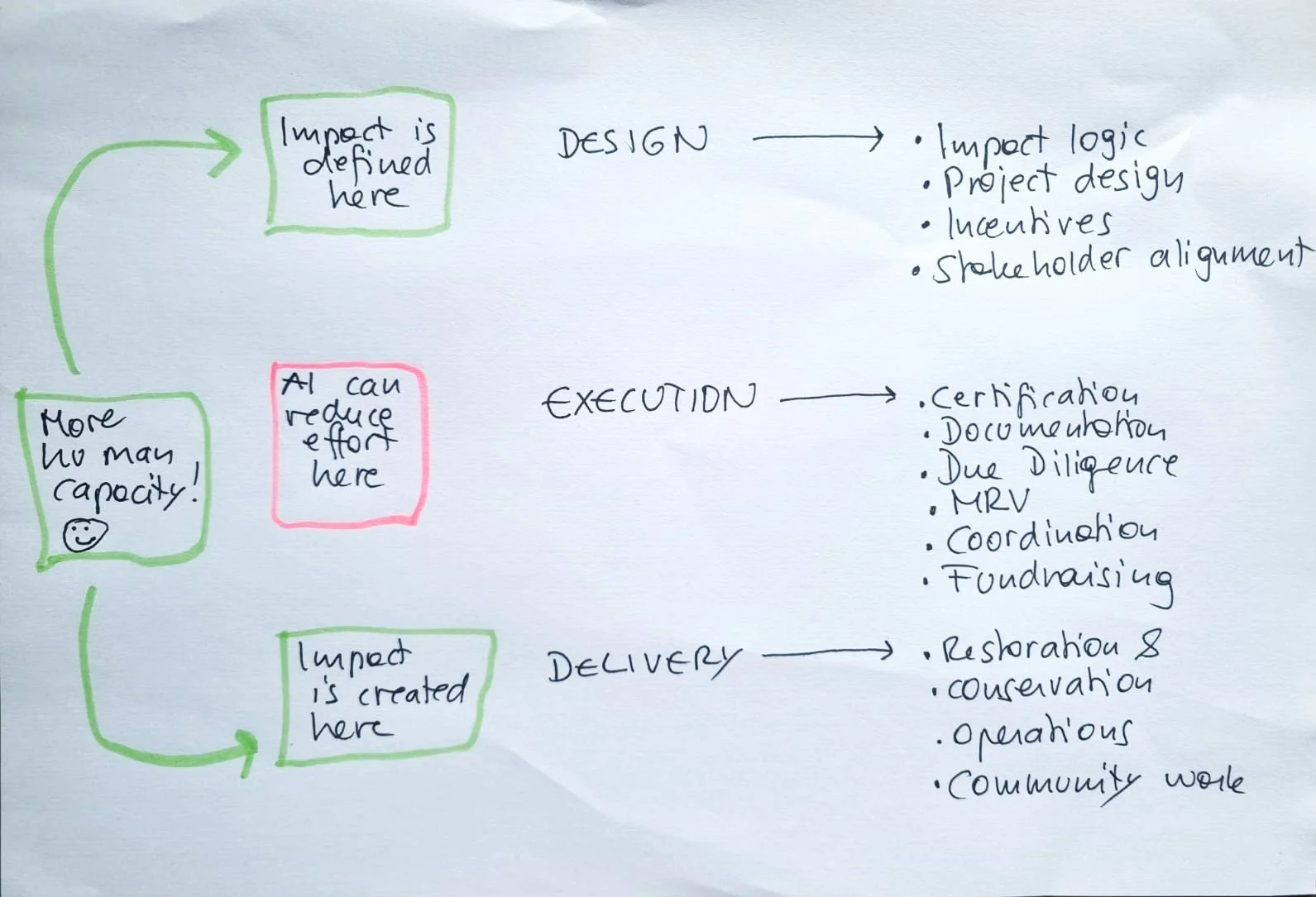
In nature-based solutions projects, AI is reducing effort in execution. But impact is still defined in design and created in delivery. What we do with that freed capacity will determine whether outcomes actually improve
“This is less about adopting AI tools. It is more like organisational redesign at a system level.
Introducing a new, highly efficient resource into a system always requires adaptation. In this case, that means rethinking:
how project development teams are structured
how roles are defined and what skills are needed
how decisions are made
and where human attention is focused
Further reading:
Where technology actually creates value and impact in nature based solutions carbon markets?
A simple way to think about this is to separate the system into three layers.
At the top sits design: where impact logic, incentives, and project structure are defined.
In the middle sits execution: where workflows, documentation, and coordination happen.
At the bottom sits delivery: where real-world impact is created through implementation, restoration, and engagement.
In overall resource efficiency terms, AI (in the way it is discussed in this article) primarily affects the middle layer. It reduces effort in execution. The opportunity is to shift human attention toward the top and bottom layers - where decisions are made and impact is delivered.
Looking ahead: AI has the potential to enable impact across many aspects
This article has focused on one immediate effect of AI: reducing friction in early-stage project development and how it can move the needle for projects. That alone is significant, because it addresses one of the key barriers that has limited the growth of nature-based projects.
But the implications of AI touch on many different aspects: AI can also support better data systems, improve due diligence, strengthen transparency, and enhance how projects connect to markets. It can enable more inclusive engagement and improve how information is shared and understood. And, of course, it has been used to strengthen tech-based monitoring systems for years now. Like any tool, its impact depends on how it is used.
In a future article, I will look more closely into how AI can facilitate co-creation with communities and reducing knowledge assymetries across the nature finance value chain.
In May, I will look more widely at the role of technology for nature based solutions and forestry - covering both nature tech and AI. I will be presenting at the Institute of Chartered Foresters National Conference in Wales.
We have a choice
AI is changing the resource structure of this market. It is removing constraints that have held projects back for years. That creates a real opportunity - to make projects more feasible, more investable, and ultimately more impactful. But it does not guarantee that outcome. We can use this shift to move closer to real impact.
Or we can absorb it - and stay where we are.
A final note
I work with organisations navigating exactly these kinds of transitions - where systems, tools, and expectations are shifting at the same time.
Often the challenge is not a lack of ambition or capability, but a lack of alignment:
between design and execution
between effort and impact
between what is possible and what is actually being done
If this resonates with what you are seeing in your work, feel free to reach out. stefanie@kaiserenvironmentalmarket.
