When Decisions Stall: The Hidden Bottleneck in Nature-Based Solutions
What Booking a Family Holiday Taught Me About Nature Finance, Human Decision-Making, and Why Complexity Makes Acting on Intent Harder Than It Looks
By Stefanie Kaiser
In complex sectors like nature and impact finance or the nature-based solutions ecosystem, one factor shapes outcomes at every stage of the value chain: human decision-making. Whether it’s misalignment between departments in a corporate setting, or individual and collective behaviour within local communities, it’s often people - not capital or frameworks - that determine whether good intent makes it through to delivery. At the most basic level, it comes down to motivations, incentives, pressures, needs and wants.
Understanding this is essential if we want to make a sector work that depends on the joint efforts of funders, operators and land stewards - often across cultures, disciplines and time horizons.
This dynamic doesn’t just show up in boardrooms or investment committees. It shows up in very ordinary situations, where the stakes feel manageable and familiar.
This post uses a simple, everyday life example to explore what happens in the critical moment between intent and action — and why moving from vision to delivery in nature-based solutions often requires a specific kind of guidance to navigate ambiguity and move past analysis paralysis.
Case study: holiday booking attempt #1.
When choosing feels harder than not choosing
This week, two events happened that reminded me why I decided to start my advisory. One of them was that last night, I finally made the first step in booking a specific family holiday. After 2.5 years. Picture this situation:
I’d like to think of myself as an experienced holiday planner. I’ve travelled a lot, I enjoy researching options, and I’m motivated to find something that really fits. And that, as it turns out, was part of the problem.
After years of solo travel for work, I wanted to take my two (now older) kids on a holiday that reflected what I care about - nature, different cultures, being active. I started with a loose wish list that sounded simple enough: a mix of jungle and beach, somewhere warm, not too exhausting, and ideally something meaningful we could experience together.
Very quickly, that wish list turned into stress.
Because I hadn’t been to most of the places I was researching, I lacked any real “feel” for what would work. I jumped between my go-to regions of Central America, Colombia, and Brazil, and eventually broadened the search to Thailand (out of my comfort zone). And each time I started a new search project, I discovering new variables, new trade-offs, new doubts. It got bigger and bigger, stress levels rising. Often it ended up with a trip to the pub and with throwing the towel, in fact. As I researched more, my criteria multiplied instead of narrowing. I contacted responsible travel companies, compared tours, questioned whether things would feel too packaged, too touristy, or somehow not “me”.
Objectively, there were plenty of good options. Subjectively, I felt increasingly paralysed.
After weeks of back and forth - and a lot of mental energy spent - I gave up and postponed the whole idea for another year. I think I had 2 or 3 ‘rotations’ of this. Not because I didn’t care, but because choosing felt harder than not choosing.
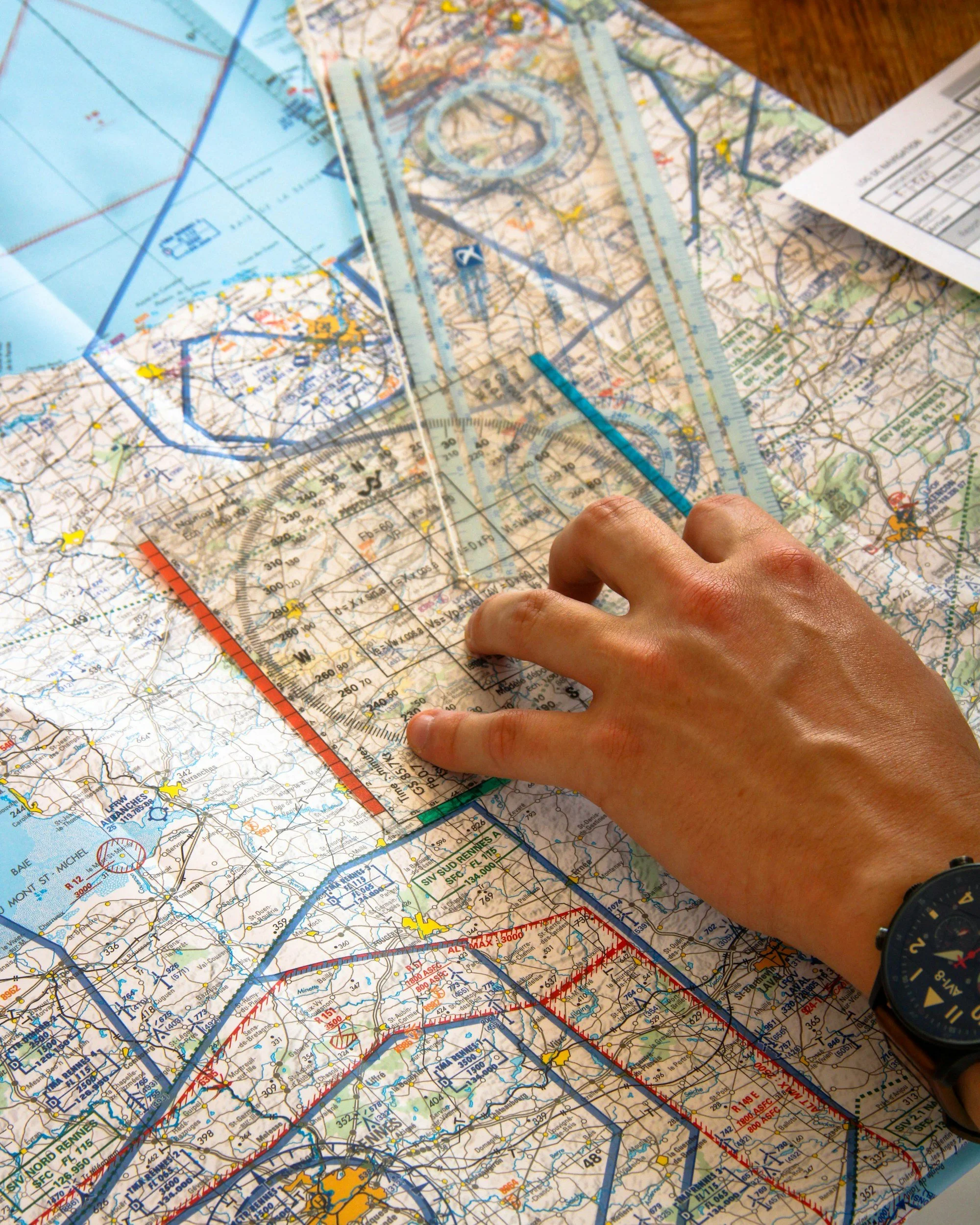
That moment just before deciding
In a growth marketing workshop I attended, this was described as the anxiety that peaks just before a decision ; the moment when complexity pushes people back to the status quo. I felt very validated, indeed!
If you have ever experienced something similar in your private life – how do you think this human behaviour could manifest in emerging sectors, where urgency and intent are strong, the rules of play are not established, new options constantly arise, different actors have different incentives and needs, and complexity is mind boggling.
From everyday decisions to systemic ones
Let’s pause for a moment and compare decision making for my holiday booking with decision-making in the nature-based solutions and nature finance sector.
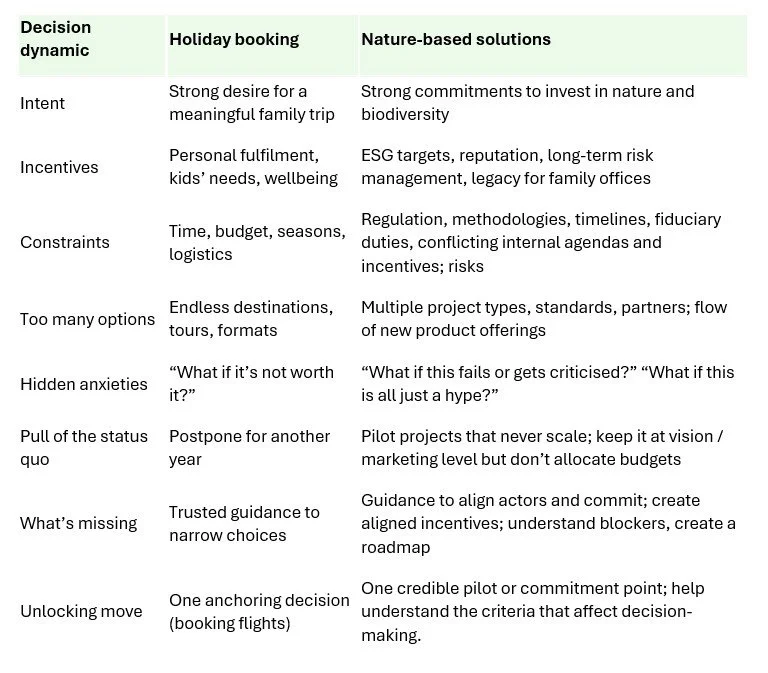
I’m sure you might think of many, many other points in this ‘nature-meets-business universe’ where the same challenge appears. I’d love you to comment!
Case study: holiday booking attempt #2
Getting out of paralysis
Fast forward a year from my last attempt. Last night, I booked flights for me and my kids to Brazil for October. No stress. A strong sense of relief and excitement. Same starting point, very different outcome.What changed wasn’t the complexity of the decision - it was how I approached it.
This time, I recognised that what I needed first wasn’t the perfect itinerary, but some initial structure and orientation. Guidance. I needed help narrowing the decision space and identifying a safe first step. Once that was in place, committing became possible.
Moving forward
Booking the flights did a few important things. It anchored the process. It reduced the number of open questions. And it created momentum without forcing me to decide everything at once. I now have enough clarity to plan the rest incrementally, using my own judgement and the advice of people I trust.
Tools like ChatGPT can help turn complexity into structure, but they don’t replace judgement or lived experience. They can support decision-making - they can’t guide it. That still comes from people who can help you make sense of ambiguity and move forward with confidence.
Why hesitation matter far more in nature finance
In consumer contexts, the cost of decision paralysis is usually limited. A washing machine isn’t bought. A fridge keeps leaking for another year*. The seller misses a sale. In nature and impact finance, the consequences are far more serious.
When funders, corporates or institutions stall at the point of commitment, capital doesn’t flow, projects don’t get delivered or scaled; in the meantime, the window to act for nature narrows. Nature loss accelerates - and with it, material risks to business itself. Unlike consumer markets, nature doesn’t have the luxury of time.
Nature soon only in the ‘zoo’?
The missing layer: enabling decision-making
This is why decision-making has become a critical bottleneck in the nature-based solutions space. Alongside the digital and financial infrastructure being built to support emerging nature markets (Kudos to people like TransparenC, Hedera, Straatos, Kana), there is an equally urgent need for social and decision-making infrastructure - the human layer that helps align incentives, translate across disciplines, and enable timely, confident action (@natalie Fuchard)
This is where bridge builders, educators and guides play a crucial role: not by simplifying the challenge, but by helping people move through complexity without freezing at the moment that matters most. And the trend is going in the right direction. It has shown in the move from start ups that provide new options and innovative solutions, to start ups and professionals who build systems to make sense of the options.
Over the last 2 weeks, I was especially inspired by the following bridge-builders and connectors:
Natalie Fruchaud | Family Office | Certified Life Coach | Executive Coach) and executive coach Alan McColm for letting me experience that exhilarating feeling of unlocking the next step.
Sid Karthivel* of Unlock Growth | Strategic Growth Marketing Partner | Edinburgh for a great lesson on growth marketing and his wonderful leaking fridge example.
Andy Creak of Kana Earth and Fran Garray of Straatos (allcot.io ) for their efforts to build operating systems for carbon and biodiversity markets and overall provide clarity of concepts and streamlined workflows.
Connecting the dots
I’m Stefanie Kaiser - I love trees and forests and think about ecosystems. I like to observe patterns and draw parallels between disciplines and systems. In this post, that meant connecting:
Growth marketing: how decision anxiety peaks just before commitment. (Hint: can Nbs learn from advertising?)
Human behaviour: how analysis paralysis plays out in a familiar, low-stakes setting (Reading tip: Behave: the biology of human behaviour at its best and worst).
Nature-based solutions and impact finance: where the human dynamics can stall decisions with disastrous consequences for nature, and therefore business and life itself.
