The Missing Layer in Nature Markets: How Communicators are Essential as Coherence Architects

‘Natural Capital markets’ have developed rapidly over the last few years. We have built nature accounting methodologies, due diligence frameworks and impact monitoring tools like there is now tomorrow. In 2026, the focus has shifted towards designing fit-for-purpose operating systems capable of channelling substantial private capital into the effective creation of impact for nature and people. Does this mean that the sector is about to reach adulthood? Maybe. One critical layer remains underdeveloped: the governance and communication architecture that ensures the multiple components of nature finance function coherently rather than being underutilised in fragmented isolation.
Using the recently released IPBES Business and Biodiversity Assessment as a reference point, this article explores why maturing nature markets now require a new professional layer focused on system coherence. And why this is, at its core, about communication.
A Market Being Built in Real Time
“As someone with a deep interest in people and systems, I have found it fascinating to watch a new market form almost in sequence, much like a start-up ecosystem where new professional groups enter as the product matures.
Over the past few years, the nature and biodiversity field has moved fast. The first big shift was cultural. Ecologists, conservation scientists and environmental advocates were invited into the business community. When I worked for an impact investing start-up in 2011, there was still a visible divide between finance and environmental activism. Banks and Greenpeace belonged to different worlds. From around 2022 onwards, corporates began forming dedicated nature teams. Specialists in ecological integrity, baselines and accounting methodologies became part of strategic conversations. Social safeguards thinking entered the mainstream. Ecological and social narratives became acceptable in boardrooms.
Soon after came the technical wave. Remote sensing specialists, software engineers and MRV experts built tools to measure biodiversity and convert ecological change into data. Naturetech, web3 experiments, AI-enabled analysis. The sector moved from principle to instrumentation.
More recently, attention shifted towards infrastructure. Tools and applications needed a home within functioning systems. Asset management logic, portfolio design and governance models from energy and finance began to be adapted for biodiversity and nature data value chains. This was a significant step because it allowed the power of measurement tools to be leveraged within structured systems. It required a different mindset, often driven by professionals entering from outside the traditional conservation bubble.
Emerging markets evolve through phases. Nature markets are no exception.
In the early stage, legitimacy is paramount.
In the second, measurement and digital infrastructure are built.
In the third, operating systems bring coherence to fragmented tools.
We are now entering a fourth stage.
This stage requires social systems architects. These are professionals who work across domains. Governance designers. Theory of change specialists. Cross-sector translators. Community engagement strategists. Disclosure architects. Organisational facilitators. Leadership coaches.
Their role is not primarily to write stories. But they will use communication to play an important role: to ensure that impact logic, perspecties and incentivces of actors in the system, data frameworks, financial positioning and community realities are aligned from the outset. Without this layer, the market will struggle to take off.
Communication as the Missing Operating Layer
Communication is about information alignment. Words are information, but so are attitude, culture and data.
I consider myself to be a communicator. Communication for me is not as narrow as marketing. It does not refer only to branding or storytelling as a surface activity. Communication as I see it refers to the operating layer that connects science, data, capital and community into one defensible logic of impact. Without that layer, impact claims, governance structures and data systems begin to drift apart. Not dramatically at first. Quietly.
The recent IPBES Business and Biodiversity Assessment makes this visible, even if it does not frame it in these terms.
The report identifies five dimensions required for an enabling environment:
Policy and legal frameworks
Economic and financial systems
Social values and norms
Technology and data
Capacity and knowledge.
Three of these dimensions are explicitly relational:
social values, norms and culture
technology and data
capacity and knowledge
Each depends on how meaning is framed, interpreted and operationalised.
IPBES also calls for bridging scientific knowledge, Indigenous and local knowledge, and business decision-making. It emphasises that disclosure should lead to informed action rather than remain a compliance exercise. It highlights the need to align profitability with biodiversity outcomes.
None of these transitions occur automatically. They require professionals who can translate between systems, surface implicit assumptions and design decision architectures that integrate rather than fragment.
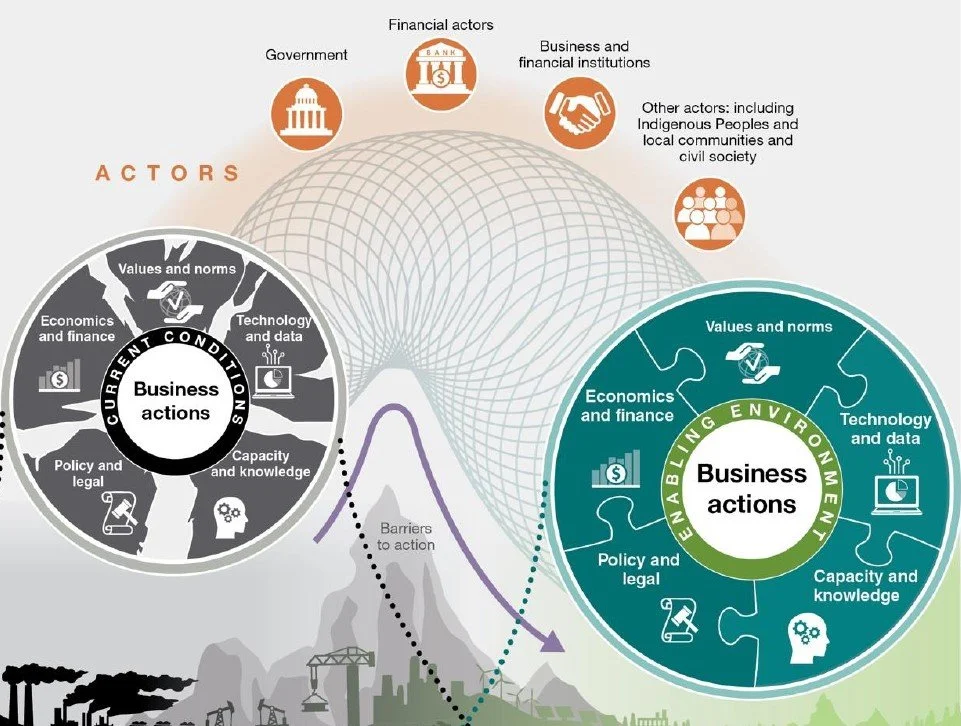
Figure SPM.2 from IPBES Business and Biodiversity Assessment, summary for policymakers. Creating an enabling environment would align what is beneficial for businesses with what is beneficial for biodiversity and nature’s contributions to people.
What the IPBES Recommendations Actually Require in Practice
Below is a practical look at selected IPBES messages and the communications and alignment work they depend on.
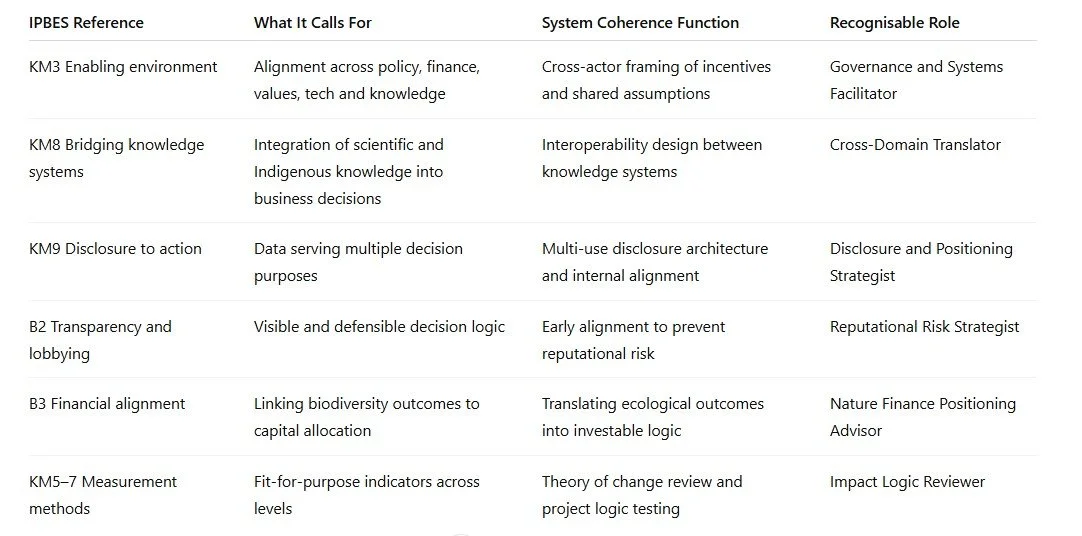
IPBES key messages and action recommendations
(KM = Key Message; B = Background message in the IPBES Business and Biodiversity Assessment)
This is not about adding a communications workstream at the end of a project. It is about structuring decisions, aligning assumptions and designing reporting and governance in a way that makes these recommendations workable in real organisations.
Where Communication Shapes Decisions and Helps Deliver on the IPBES recommendations
When communication is treated as an operating function rather than an output, it influences how impact is defined, how data is interpreted and how responsibilities are assigned.
In practice, this can mean:
It can mean:
interviewing scientists and Indigenous representatives separately, identifying where their definitions of impact converge and diverge, and building a shared framework that allows both systems to remain intact while becoming interoperable.
reviewing a biodiversity credit initiative and identifying where the stated impact narrative cannot be supported by the selected indicators, before that misalignment becomes a credibility issue.
designing reporting structures so that one biodiversity dataset serves regulatory disclosure, investor reporting, internal strategy discussions and community transparency simultaneously.
facilitating leadership conversations between community actors and capital allocators so that both operate from a shared theory of change rather than parallel assumptions.
In each case, communication is not the final output. It is the mechanism that structures decisions.
Why communication and coherence matter in times of change
The sector has reached a point where measurement tools and digital infrastructure are no longer experimental. They are increasingly sophisticated and scalable. AI and automation are accelerating technical capacity. The constraint is no longer whether we can process data. The constraint is whether we can interpret it consistently, frame it responsibly and align it across domains. In addition, we now have AI as yet another actor in the room. Another player to communicate and align with.
At the same time, regulatory expectations are tightening. Disclosure requirements are expanding. Investors are scrutinising claims more closely. Communities are demanding transparency that is meaningful rather than performative. In this environment, communication becomes structural. It determines how impact is defined, how trade-offs are explained, how data is translated into decisions and how responsibilities are distributed across actors.
When those elements are not aligned early, the consequences surface later as reputational risk, investor hesitation or community mistrust. The role of communicators in maturing nature markets is therefore not about amplification. It is about interpretation, framing and decision design.
System coherence is not a soft skill. It is risk management and strategic positioning.
Where I Work
My work sits primarily within the dimensions of social values and culture, technology and data, and capacity and knowledge identified by IPBES. I am a communicator and connector and work inside nature and biodiversity initiatives where science, data, governance and capital meet.
I review impact logic before it scales.
I align data systems with decision processes.
I help initiatives articulate defensible positioning within evolving regulatory and financial environments.
I help ensure that governance, measurement and narrative do not drift apart.
In maturing nature markets, this is not an optional addition. It is part of building a functioning system.
In subsequent articles, I will talk about the role of AI for impact, and talk more about impact logic and examine how to test whether your measurement approach is actually capable of detecting the change you claim.
If you are building a product, a platform or a finance mechanism in this space and sense that your science, data and positioning are not yet fully aligned, that is not a weakness. It is a sign that your system is maturing. Addressing it early is what turns experimentation into structure.
