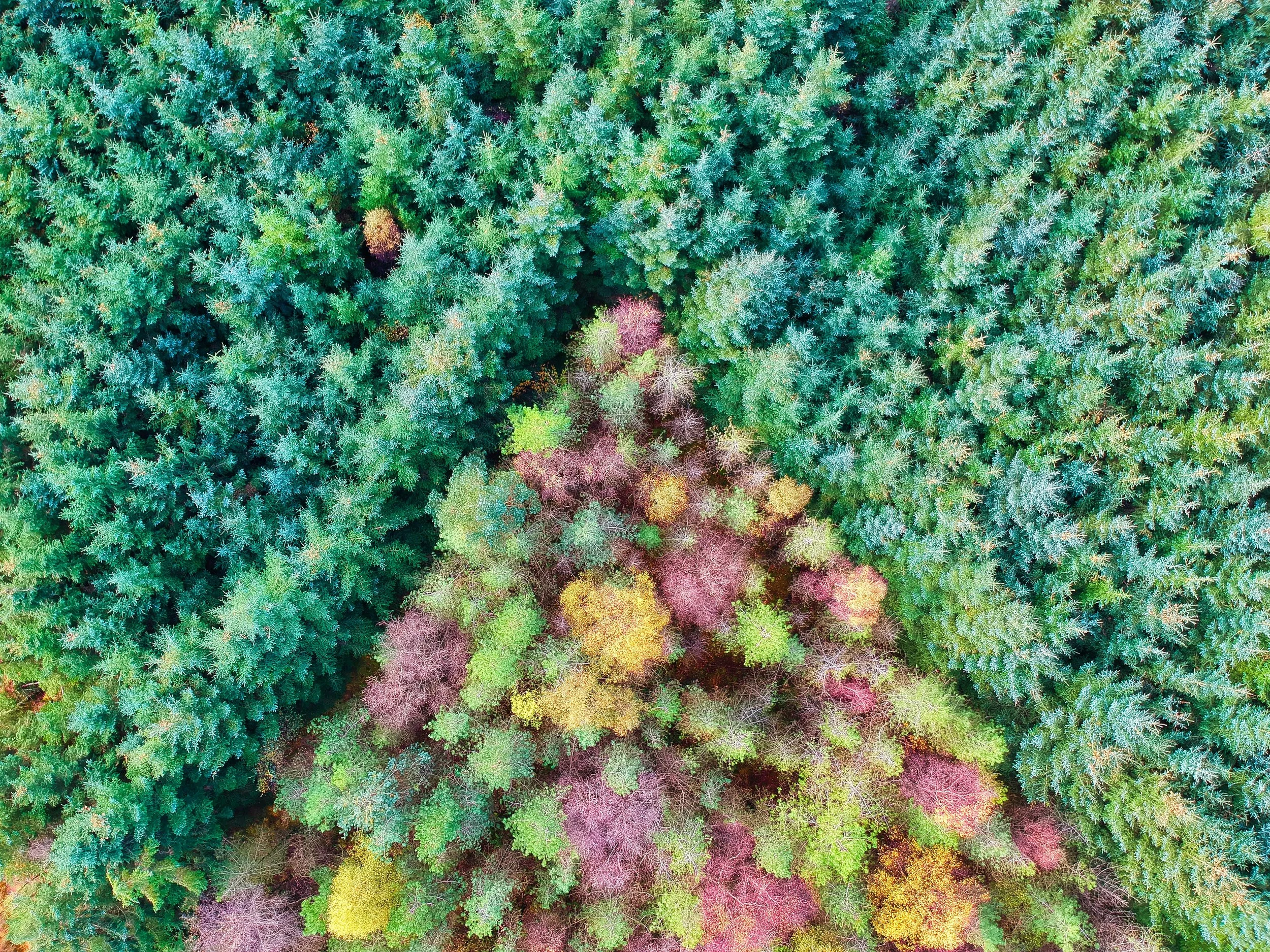
Photo by Red Zepelling for Unplash. For illustrative purposes only, not a valid representation of the type of multipup
How can we combine forest-product revenues with ecosystem-service payments without adding more costs, complexity and risk than value?
I've written before about why carbon should be one part of a multipurpose forest business, rather than the reason the whole forest has to justify itself. I keep coming back to this subject, and increasingly to the practical question of how to make the different opportunities work together.
Forestry businesses and land owners want forests to produce timber and other goods, while there is an increasing imperative to protect biodiversity, store carbon, regulate water and generally provide essential ecosystem services that benefit wider society. Managing for these different purposes involves costs, trade-offs and long-term responsibilities for land owners and managers. Finding ways to reward them for the delivery of a meaningful suite of forest outputs is therefore important.
Timber and other forest products already have established markets. Alongside these, there are now ways to generate income from ecosystem-service outcomes, through carbon and biodiversity credits, verified impact claims and other payment arrangements. I’m focusing here on market-based approaches. The attraction is clear: several sources of income from the same forest could help finance better and more nature-positive land management.
“ But when a forest business already sells certified products, how can it add ecosystem-service income without creating conflicting claims, duplicated costs or risks that outweigh the additional revenue?
I've been thinking about this recently through two different experiences with FSC: participating in the working group developing its biodiversity credits procedure, and training as an FSC Forest Management auditor with Soil Association.
What I find particularly interesting is FSC's ambition to build on its established forest management certification and offer forest owners more ways to demonstrate and be rewarded for the environmental outcomes they deliver. Alongside certified forest products, FSC already offers Verified Impact claims and is now developing procedures for biodiversity and carbon credits.
It's an exciting direction, and one that brings some interesting questions into focus. Looking at the requirements of responsible forest management and those of emerging environmental market products side by side, I've become particularly interested in how these different offerings can build on one another, where their boundaries need to remain clear, and how to make the combination worthwhile for forest managers and buyers alike.
1. The opportunity: more than one source of income
There's nothing particularly new about generating several revenue streams from one piece of land. Forest businesses have long combined timber production with other activities, depending on what the land can support and what the market will pay for. Environmental markets add further possibilities.
These can involve generating different environmental outcomes from the same area, or managing different parts of a forest management unit (FMU) for different purposes. The arrangements vary, and so do the rules about what can be claimed, sold or combined. Additionality is obviously the key issue here.
Within ecosystem-service markets, this is familiar territory. Stacking generally refers to separately marketing different ecosystem-service units from the same land, while bundling brings several benefits together in one offering. Julia McCarthy and Ryan Sarsfield provide a useful explanation of the different approaches and the challenges around additionality, overlapping outcomes and double counting in Beetles in a Pay Stack.
And whilst environmental credits were pitched as a game changer for nature finance, we increasingly seet that they don’t necessarily have to carry the whole business case but play a supporting role to make a business viable and allow for more nature-positive elements of the management plan to be financially viable.
Eoin Murray makes an important distinction in his writing on nature finance: the economic value of nature isn't the same as revenue that can actually be captured, and that revenue isn't necessarily reliable enough to support investment. In Why nature finance keeps stalling at credit, he argues that credits may work better as supplementary income alongside more dependable payment arrangements.
This supports the case for looking at the full range of opportunities available to a forest business, rather than relying on a single environmental product. But how we combine those opportunities matters.
2. Where does one product end and another begin?
Take a forest that already produces FSC-certified timber and wants to generate additional income from biodiversity outcomes. FSC Forest Management certification involves extensive environmental and social requirements. Principle 9 of the FSC’s international generic indicators is about protecting and maintaining High Conservation Values (HCVs), which cover important ecological values as well as ecosystem services, community needs and cultural values. There are six types of HCVs including those of cultural value. Meeting the strict requirements on how to identify, manage and monitor HCVs are not optional extras. They are compliance requirements for forestry businesses and will be audited each year.
Responsible sourcing standards such as FSC have increasingly moved beyond preventing unacceptable harm to include maintaining and enhancing environmental values. From an impact perspective, this is welcome progress. We want responsible production to contribute positively to nature. But from a product perspective (ie looking at timber and ecosystem service credits as possible forest products), it raises an interesting question.
“If a forest manager is already required to maintain or enhance certain environmental values to produce certified timber, what additional outcome can be marketed separately - and what would the buyer be paying for?
“There are methodologies and we know how to deal with additionality” is a thought that would initially come to mind. And yet, the line where forest certification ends and additional nature impact that can be turned into a marketable credit begins is not always straightforward. Additionality again (which I know is in itself a controversial topic).
Different markets have different approaches to baselines and additionality. Some payments support conservation or the maintenance of valuable ecosystems, while others require demonstrable improvements beyond a defined baseline. And not every environmental payment is a tradable credit.
Also, the different products have different buyers with different incentives and business cases and also different incentives to pay premiums. A timber buyer may want assurance that its products come from responsibly managed forests. Another company might want to support conservation and communicate that contribution (a verfified impact, maybe). A buyer of a tradable environmental credit may need a clearly defined and verified unit, together with clarity about the claim attached to it. This also affects the level of granularity and quantifification we need to define each of these products.
These are different commercial propositions and products, even where they involve the same forest.
The challenge is to define them clearly enough that the claims retain their integrity and their value to buyers, while making the most of the environmental work already being done.
3. Integrating systems: an opportunity, with trade-offs
There are obvious reasons to make different certification and verification systems work together. A certified forest manager may already have management plans, monitoring systems, stakeholder engagement processes and substantial evidence of environmental performance. It makes sense to build on that work wherever possible rather than asking managers to demonstrate similar things repeatedly. Because, in particular the safeguards aspects can involve a lot of work that doesn’t necessarily add to the businesses baseline but is required as part of certification and best practice. Where verification can be coordinated, there may also be opportunities to reduce audit and administration costs.
“The opportunity is to share what can sensibly be shared without losing the boundaries that make each product credible.
But there's a balance to strike. Requirements that appear similar may serve different purposes. Evidence sufficient to demonstrate compliance with a forest management standard isn't necessarily enough to substantiate a separately marketable environmental outcome.
And integrating systems can create dependencies. My recent auditor training has made me think more carefully about this. Audit findings and certification decisions can have real commercial consequences for a forest business. For example, if there is a suspension - worse even, if there is a suspension in a group scheme because of one member, let’s say. If another environmental product depends on the status of an existing certification, we need to understand what happens when requirements aren't met. The consequences depend on the particular rules and contractual arrangements; integration doesn't automatically mean that a problem with one certification invalidates every other claim. It’s an aspect that requires some thorough thinking and lots of input from practitioners until the right solution is found.
So the question isn't whether integration is good or bad. A useful question for forest businesses and those designing and delivering environmental market mechanisms alike is
“how much can we gain by sharing systems and reducing costs, and where should we maintain separation to protect the different claims and manage risk?
4. But what will the market actually pay for?
I spend a lot of time in discussions about how environmental outcomes can be delivered, measured and verified. These are important questions, and often technically demanding ones. And I love getting into the weeds of product discussions in environmental markets. But I keep coming back to the product and market perspective, because ‘relevance’ for both nature and markets is one of the three criteria I internally use for navigating trade-offs (relevance, robustness, feasibility).
Who is going to buy it? What value does it offer them? And how much are they prepared to pay? These aren't revolutionary questions. They're the questions we'd ask about any commercial product. Yet when we're deeply involved in developing standards, methodologies or technical solutions, it's easy to become absorbed in our own specialities. Perhaps we need to make a habit of looking at the forest, rather than getting lost among the trees. We can develop increasingly sophisticated approaches to demonstrating environmental outcomes. And we should: credibility and integrity are essential.
“A credible product isn't necessarily a product someone wants to buy.
Responsible sourcing certification (FSC, Rainforest Alliance, Fairtrade) can provide market access and sometimes a price premium. But increasing environmental requirements doesn't automatically mean buyers will pay more for timber. Likewise, creating a credit doesn't automatically generate income. Demand depends on what buyers value, what they can legitimately claim and what they are prepared to pay.
Perhaps a separately tradable credit is the right approach. Perhaps improved environmental management is better rewarded through an existing supply chain, a sourcing agreement or a contracted payment for outcomes. There's no reason to assume that every ecosystem service needs its own separately tradable product. What matters is finding an arrangement that is relevant to buyers, robust in terms of environmental outcomes and feasible for those delivering it.
I like the idea of having a limited but robust menu of market options that allows forest owners and managers to pick from. Right now, we are in the weeds of creating this menu and getting the market relevance, feasibility for owners right whilst not neglecting credibility.
5. Additional revenue, yes please. But at what cost and whose risk?
Even where a new revenue opportunity looks promising, we need to examine what comes with it. What will it cost to establish, monitor, verify and maintain the outcome? What revenue can realistically be expected, and when? What commitments does the forest manager take on, potentially over many years? We are well aware that project developers and forest managers are often left with more than their fair share of costs and standard developers do take this into account.
Another consideration: what happens if things don't go to plan? How is risk dealt with and who carries it? Forest managers may have to invest long before receiving income. They may face changing environmental conditions, prices, verification requirements or buyer demand. If different claims and certifications depend on one another, a problem in one area could have wider consequences. Some risks can be managed, some shared, and others may need to be reflected in the price or contractual arrangements. It’s a big discussion in the carbon market world and, as we bring environmental markets into the traditional timber forest management sector and start to integrate the two worlds, we need to really think about this aspect.
“A new revenue stream isn't necessarily an improvement if its additional costs, obligations and risks outweigh the benefits.
That's why we need to look at the economics of the whole forest business, not just the projected value of another credit or claim.
6. Making the different opportunities work together
I welcome the development of new mechanisms for rewarding the environmental outcomes forests provide. The more credible options available, the more scope there is to find approaches suited to different forests, management objectives and markets.
But more isn't automatically better when it comes to applying them to an individual forest management unit. We need to look at the possible products and payment arrangements together.
Which environmental outcomes can legitimately be rewarded separately?
Which might be combined?
Where can we use existing management and verification systems?
What are the likely costs, buyer demand and revenue?
And how are responsibilities and risks distributed?
Then comes the question that matters for the business as a whole: does the combination create sufficient additional value to make better forest management financially worthwhile?
None of this is new territory. There is already considerable specialist work on stacking, additionality, market integrity, finance and risk. And it's encouraging to see standards organisations and market participants developing more options for land managers.
What I think matters is bringing those perspectives together when practical decisions need to be made. I like to look at these questions through two lenses:
The impact lens asks whether we're delivering and demonstrating meaningful environmental outcomes.
The product lens asks whether we're creating something that buyers value, whether the price supports delivery and how the costs and risks are shared.
We need both. And we need to understand how decisions made in one area affect the other.
That's the part of my work I particularly enjoy: bringing together the people and perspectives involved in forestry, environmental standards, project development and finance, and helping turn different pieces of a proposition into something workable. The FSC working group for the development of the biodiversity credit procedure has been a fantastic platform for these discussions to take place - a great group of people that are aligned in thinking but challenge each other.
Working across impact, commercial opportunity and delivery
Through Kaiser Environmental Markets, I work with forest and land-based businesses, project developers, investors and specialist partners on the practical and commercial questions behind nature-related initiatives.
That includes assessing opportunities, testing assumptions, examining delivery and stakeholder requirements, and helping teams understand where their plans, incentives and responsibilities need to align. Where specialist ecological or financial expertise is needed, I work alongside the people who provide it.
If you're exploring how to combine forest-product revenues with ecosystem-service payments, reviewing the viability of a nature-based initiative or developing an environmental offering for a real market, I'd be interested to hear what you're working on.
